

Vintage perfumes are not simply old scents; they are pieces that carry history, memories, and fragrance compositions from different eras. Therefore, evaluating a vintage perfume requires understanding its nature, how it was preserved, and the changes it may have undergone over the years.
Collectors of rare perfumes may notice that the first few sprays from an old bottle have a slightly different scent than the perfume itself. What is the reason for this? Does it mean the perfume has oxidized or lost its quality?
How does a perfume spray pump work?
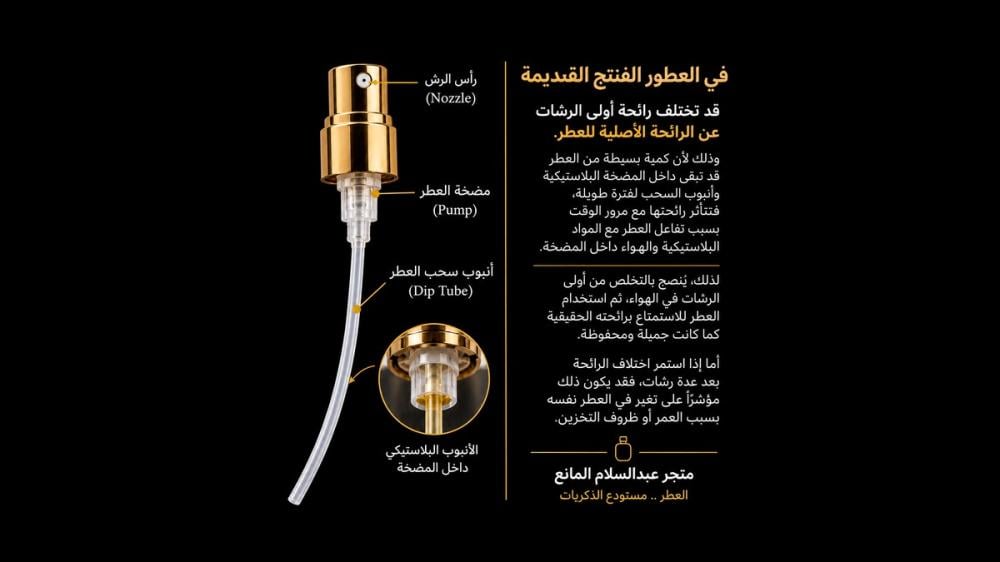
A perfume spray pump typically consists of several main parts:
- Spray nozzle: The opening from which the perfume comes out in the form of a spray.
- Pump mechanism: The part that helps to draw the perfume out and push it out when pressed.
- Dip Tube: The tube that extends inside the bottle to transfer the perfume to the pump.
These parts work together to deliver the fragrance from the bottle to the outside. A small amount of fragrance may remain inside the spray nozzle or pump parts after previous use, and the conditions of this remaining amount differ from those of the fragrance stored inside the bottle.
Why might the scent of the first sprays be different?
1. Perfume residue inside the spray head and pump
A small amount of fragrance may remain in the spray nozzle after use. This residue may evaporate or dissipate into the air, resulting in a temporary difference in scent upon initial use.
2. Chemical changes over time
Perfumes contain multiple aromatic compounds, some of which are affected by oxygen, heat, and light to varying degrees. Some of these changes are known as oxidation, and they can lead to the appearance of unusual notes or alter the balance between the perfume's components.
But it is important to distinguish between the change that occurs in the perfume residue inside the pump and the change that affects the perfume inside the bottle; they are not necessarily the same.
3. The nature of the materials used in the pump
Perfume pumps vary in design and the materials used in their internal components. The nature of these materials and their compatibility with the fragrance composition may affect the perfume's behavior during long-term storage, but the pump itself cannot be considered the sole cause of every difference in scent.
4. Storage conditions
Old perfume can be affected by high temperatures, repeated exposure to light, and improper sealing. Therefore, two bottles of the same perfume may retain different fragrances if their storage conditions vary over the years.
Should the first three sprays be discarded?
Advice is widespread to discard the first three sprays when using old perfumes, but there is no fixed number of sprays that works for all perfumes and bottles.
One or two sprays may be enough to clear the spray pattern, and there may be no noticeable difference at all. A practical method is to spray one or two away from your face, avoiding inhaling the mist directly, and then test the fragrance on a clean scent tester.
If the scent becomes closer to what you expected, the difference may be related to fragrance residue within the spray pattern. However, if the difference persists, it's best to evaluate the fragrance itself rather than assuming the problem will resolve with repeated spraying.
How do you assess the condition of a vintage perfume?
- Differences in the first few sprays only: This may be related to perfume residue inside the spray head or pump, but it is not conclusive evidence.
- Continued difference in scent: This may indicate a change in the fragrance itself or to other factors related to the packaging.
- Changes in color or cloudiness: warrant examination, but are not sufficient on their own to judge the condition of the perfume.
- The persistent appearance of an unfamiliar odor may indicate a change in composition, especially if accompanied by other changes.
It is best to compare the scent with what is known about the same edition, if possible, keeping in mind that some perfumes have changed their compositions or production batches over the years.
How do you preserve vintage and rare perfumes?
- Store the bottles in a relatively cool and temperature-stable place.
- Avoid direct sunlight and high temperatures.
- Keep the lid tightly closed and avoid opening the bottle unnecessarily.
- Avoid storing perfumes in the car or in places that are exposed to large temperature fluctuations.
- Keep the original box whenever it is available.
- When buying a rare perfume, examine the bottle, pump, liquid level and appearance, and do not rely on a single factor to determine its condition.
Does a change in scent mean that the perfume has lost its value?
Not necessarily. The value of a vintage fragrance may be linked to its rarity, history, the condition of the bottle, and collector's demand. However, it's important to distinguish between a fragrance's historical or collector's value and its actual aromatic condition.
The bottle may be rare, yet its composition may have changed due to prolonged storage. Conversely, an older bottle may retain a pleasant and balanced aroma if stored properly.
Summary
The scent of some vintage perfumes may differ from the first sprays due to residual fragrance inside the spray nozzle or pump, or because of changes that have occurred over time. However, discarding a specific number of sprays is not a scientifically proven rule, and the return of the scent to its original state after spraying is not a definitive test of the perfume's quality.
Most importantly, the smell should be assessed after removing any possible residues from the spray path, noting any persistent changes, taking into account storage conditions and the nature of the release.
In the world of vintage perfumes, small details make all the difference; knowing the history of the perfume, how it was preserved, and understanding the nature of its composition helps to appreciate its value and condition more accurately.
Abdul Salam Al Mana Store
Perfume... a repository of memories